What Is a Good Typing Speed? Average WPM by Age and Profession
You just finished a typing test, you're staring at a number, and you want to know one thing: is that good?
Short answer: the average typing speed for adults is around 40 WPM. For everyday computer use, 40–50 WPM is typical, 50–80 WPM is good, and 80+ WPM is fast. But what counts as a good typing speed depends on your age, experience, profession, and accuracy.
If you're asking "What is a good WPM?", "Is 50 WPM good?", or "What is the average typing speed?", the tables below give you practical benchmarks by age, skill level, and profession.
But that single number hides a lot. A "good" speed for a 12-year-old learning touch typing is very different from a good speed for a data-entry professional. And raw WPM without accuracy is almost meaningless — a sloppy 90 WPM loses to a clean 65 WPM in real work every single time.
This article gives you honest benchmarks by age, skill level, and job type, explains how WPM is actually calculated, and shows you what to do if your number disappointed you.
Want your real number right now? Take the free TypingBIRDS typing test — 60 seconds, live WPM and accuracy, no signup required.
How Typing Speed Is Measured
WPM stands for words per minute, but here's the detail most people miss: a "word" in a typing test is not a real word. It's a standardized unit of 5 characters, including spaces and punctuation.
So if you type 300 characters in one minute, that's 300 ÷ 5 = 60 WPM — regardless of whether you typed sixty short words or thirty long ones. This standard exists so that scores are comparable across different texts and even different languages.
There are two flavors of WPM you'll see:
- Gross WPM — every character you typed counts, right or wrong.
- Net WPM — errors are subtracted from your character count. This is the honest number, and it's what serious typing platforms report.
A test that only shows gross WPM flatters you. If a site tells you that you typed 80 WPM at 85% accuracy, your real, usable speed is closer to 68 WPM.
Typing Speed Levels: From Beginner to Elite
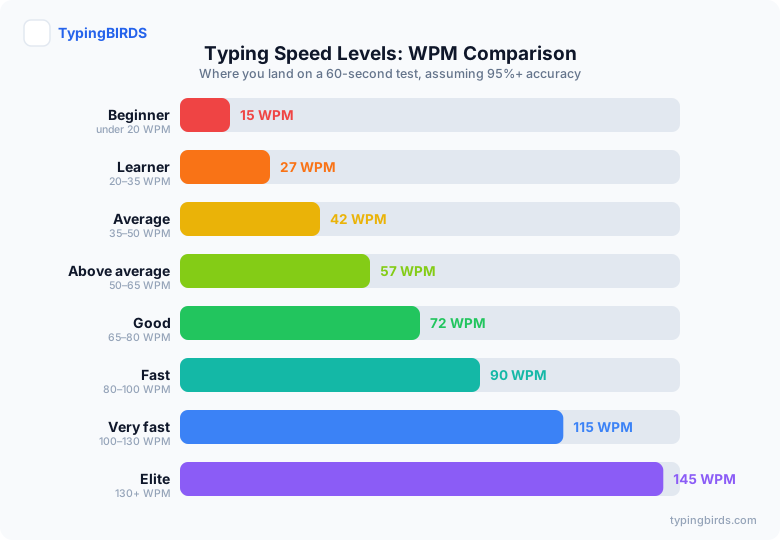
Here's a realistic breakdown of what different WPM ranges mean in practice, assuming accuracy of 95% or higher:
| WPM | Level | What it feels like |
|---|---|---|
| Under 20 | Beginner | Hunting for keys, looking at the keyboard constantly |
| 20–35 | Learner | Knows the layout, still thinks about finger placement |
| 35–50 | Average | Comfortable everyday typing; roughly where most adults sit |
| 50–65 | Above average | Types without thinking; faster than most coworkers |
| 65–80 | Good | Fluent; keyboard feels invisible |
| 80–100 | Fast | Top few percent of typists; noticeable productivity edge |
| 100–130 | Very fast | Competitive typing territory |
| 130+ | Elite | Tournament level; years of deliberate practice |
Two honest caveats. First, these bands assume prose text — normal sentences. Typing code, numbers, or a second language will lower anyone's WPM because of symbols and unfamiliar patterns. Second, your speed on a 30-second sprint is usually 10–20% higher than what you can sustain for five minutes. Both numbers are real; they just measure different things.
Average Typing Speed by Age
Age matters less than practice, but here's roughly what average typing speed in WPM looks like at each stage, based on how much keyboard exposure each group typically has:
| Age group | Typical range | Notes |
|---|---|---|
| 6–11 (elementary) | 5–20 WPM | Still learning letter positions; accuracy matters far more than speed here |
| 12–16 (middle/high school) | 20–40 WPM | Big variation depending on whether they've had formal typing lessons |
| 17–24 (students) | 35–55 WPM | Heavy computer users; often self-taught with bad habits |
| 25–54 (working adults) | 38–50 WPM | Plateaued at "good enough for the job" |
| 55+ | 25–40 WPM | Wide range; depends heavily on career keyboard use |
The most interesting thing in this table is the plateau. Many adults stop deliberately improving their typing speed once they reach a comfortable level — not because they can't get faster, but because everyday typing never pushes them. You don't get faster by doing what's already comfortable. That's why deliberate practice (racing a target, drilling weak keys) works and "just typing a lot at work" doesn't.
For teachers: if you run typing practice with a class, expect enormous spread. In a typical classroom of 25 students, the fastest kid may type four times faster than the slowest. A tool with a per-student dashboard — like Typing Classes on TypingBIRDS — helps you see who needs accuracy work versus who's ready for speed goals, instead of teaching to the middle.
Typing Speed Requirements by Profession
Some jobs list WPM requirements explicitly; for others there's an unspoken expectation. Typical figures you'll see in job postings:
| Profession | Commonly expected WPM | Why |
|---|---|---|
| General office / admin | 40–50 | Email, documents, forms |
| Customer support (chat) | 50–65 | Typing while reading and thinking |
| Data entry | 60–80+ | Speed is the job; accuracy is audited |
| Journalist / writer | 60–70 | Keeping up with thought is the real goal |
| Medical transcriptionist | 70–90 | Often tested at hiring |
| Court reporter (stenotype) | 200+ | Uses a chorded steno machine, not QWERTY |
| Programmer | 50–70 on prose | Code typing is slower; symbol fluency matters more than raw WPM |
A note on programmers, since this surprises people: raw prose WPM is a weak predictor of coding speed. Brackets, semicolons, underscores, and camelCase don't appear in normal typing tests, so a developer who scores 85 WPM on English sentences might manage 45 on real code. If you type code for a living, practice on actual code snippets — the Race page has a dedicated Code difficulty for exactly this, and it's genuinely harder than it sounds.
See where you land against your profession's benchmark. Test your typing speed now and compare your WPM to the table above.
Why Accuracy Matters More Than Speed
Here's the math that convinces most people.
Say you type at 80 WPM with 90% accuracy. One in every ten characters is wrong. Fixing a mistake isn't free: you notice it, move to it, delete it, retype it. Each correction costs several keystrokes and — worse — breaks your rhythm. In practice, a 90%-accuracy typist spends so much time repairing text that their effective output often falls below a 60 WPM typist working at 99% accuracy.
That's why the standard advice from typing instructors is blunt: never chase speed until your accuracy sits at 97% or higher. Speed built on top of errors just means producing mistakes faster.
Rules of thumb:
- Below 95% accuracy → slow down. You're practicing your mistakes.
- 95–97% → hold your current speed until errors fade.
- 98%+ → you've earned the right to push pace.
How to Test Your Typing Speed Properly
Not all test results are comparable. To get a number you can trust and track over time:
- Use the same test length each time. A 60-second test is the sweet spot: long enough to smooth out luck, short enough to repeat daily.
- Test on prose first. Normal sentences give you the standard benchmark; code and numbers come later.
- Take three runs and keep the median. Any single run can be a fluke — a hard text, a cold start, a lucky streak.
- Record accuracy alongside WPM. A WPM number without its accuracy is half a result.
- Test warmed up and cold. Your "walk up to a keyboard" speed is what matters at work; your warmed-up speed is your potential.
The free TypingBIRDS typing test tracks both numbers in real time and keeps your personal best, so you're always benchmarking against yourself rather than a one-off score.
What to Do If Your WPM Is Low
A disappointing number is a starting line, not a verdict. In rough order of impact:
- Fix your looking habit. If you glance at the keyboard, that's the single biggest ceiling on your speed. Cover your hands or force yourself through slow, no-look sessions until the layout lives in your fingers.
- Use all ten fingers on home row. Two-finger typing often makes it harder to move beyond 40–50 WPM. Learning touch typing can remove that limitation and make higher speeds much easier to reach.
- Drill your specific weak keys. Everyone has three or four letters that cause most of their errors. Find yours (the Practice page shows per-key statistics) and drill those, not the whole alphabet.
- Practice 10–15 minutes daily, not an hour weekly. Motor learning consolidates with sleep; frequency beats volume.
- Race something. A target makes you push past your comfort pace. Racing a live replay of your own personal best — Ghost Racing on the Race page — is particularly effective because the opponent is always exactly one step better than you.
Realistic expectations: an adult practicing daily can typically add 10–15 WPM in a month or two, more if they're fixing a fundamental habit like keyboard-looking. Going from 40 to 70 WPM is a very achievable few-month project. Going from 100 to 130 takes a year of serious work — improvement gets exponentially harder at the top.
Summary
- Average adult typing speed is roughly 40 WPM; 50–80 is good; 80+ is fast.
- A "word" is 5 characters, and honest tests report net WPM (errors subtracted).
- Accuracy below 95% makes your speed number nearly meaningless — fix errors first.
- Job expectations range from ~40 WPM for office work to 70+ for transcription.
- Many adults plateau not from lack of ability but from lack of deliberate practice.
Ready to get your real number? Take the free TypingBIRDS typing test, note your WPM and accuracy, and come back in thirty days of short daily practice to measure the difference.
Frequently Asked Questions
What is the average WPM for typing?
The average typing speed for adults is around 40 WPM. A typical range is roughly 35–45 WPM, although speed varies significantly with age, experience, keyboard familiarity, and profession — see the full breakdowns above for your specific group.
Is 40 WPM a good typing speed?
It's average for adults. It's perfectly serviceable for everyday work, but most people who spend their day at a keyboard benefit noticeably from reaching 60+. If you're at 40 with high accuracy, you have easy room to grow; if you're at 40 with low accuracy, work on precision first.
Is 30 WPM a good typing speed?
It is below the adult average of 35-45 WPM but perfectly workable for casual use, and a normal speed for a student still learning touch typing. If you are an adult at 30 WPM using hunt-and-peck, learning proper technique is the single change that will lift you past 50.
Is 50 WPM a good typing speed?
Yes - 50 WPM is above the adult average and comfortably meets the requirement listed for most office jobs. It is a solid everyday speed; pushing on toward 60-70 mostly pays off for people who write or enter data all day.
Is 60 WPM fast?
60 WPM is above average for many adult typists and is a strong practical typing speed. Whether it is considered "fast" depends on the test and comparison group.
Is 80 WPM impressive?
It is - roughly double the adult average and faster than the vast majority of typists, including most professionals. At 80 WPM, typing speed stops being a bottleneck for almost any job, and further gains are about personal satisfaction more than practical need.
What is the average typing speed for a 10-year-old?
Around 10-20 WPM is typical for a 10-year-old, and 25 WPM is strong. At this age accuracy and correct finger technique matter far more than speed - see our full typing speed by grade level guide for year-by-year targets.
What is the average typing speed for a 14-year-old?
Most 14-year-olds type around 25-35 WPM, with practiced touch typists reaching 45+. A teenager who builds correct technique now often reaches 60-70 WPM by the end of high school with normal schoolwork alone, though the exact pace varies with how much they actually type.
What is the average typing speed for adults?
Most adults type between 35 and 45 WPM. Regular computer users tend toward the top of that range, professional typists average 65-75, and the large majority of adults stay below 80 WPM - which is why 60+ already stands out as fast.
Is 100 WPM fast?
Yes — 100 WPM puts you well above the vast majority of typists. It is roughly 2.5× the adult average and is the informal entry point to competitive typing.
What is a good typing speed for a 13-year-old?
Around 30–40 WPM is solid for that age, and 50+ is excellent. At 13 the priority should still be accuracy and proper finger technique — a teenager who locks in correct touch typing now will pass 70 WPM effortlessly later.
What typing speed do employers expect?
Most office roles expect 40–50 WPM. Data entry and transcription roles commonly test candidates and expect 60–80+. If a job posting lists a WPM requirement, they will usually verify it with a timed test at 95%+ accuracy.
Does typing speed include mistakes?
It depends on the test. Gross WPM counts everything you typed; net WPM subtracts errors. Always compare net-to-net — a gross score can be 10–20% inflated.
How many keystrokes per hour is 60 WPM?
60 WPM × 5 characters × 60 minutes = 18,000 keystrokes per hour (KPH). Data-entry jobs often quote KPH instead of WPM; divide KPH by 300 to convert back.
Why is my typing speed lower on some tests?
Text difficulty varies a lot. Common-word tests produce higher scores than tests with punctuation, capitals, and rare words. Test length matters too — everyone is faster over 15 seconds than 5 minutes. Compare scores only within the same test format.
Can I get faster without learning touch typing?
A little, but most hunt-and-peck typists find it hard to get much past 40–50 WPM. Hunt-and-peck requires visual attention that touch typists spend on reading ahead. Relearning proper technique feels slower for two or three weeks and then pays off permanently.
Is typing speed different in other languages?
Yes. Character-based measurement (5 chars = 1 word) makes scores roughly comparable, but unfamiliar layouts and scripts slow everyone down at first. Typing Punjabi in Gurmukhi, for instance, uses completely different key mappings — expect your WPM to start far below your English speed and climb with practice.
How long does it take to double my typing speed?
Many people move from 30 to 60 WPM in around 2–4 months of short daily practice, though the exact timeline depends heavily on how consistently you practice and whether you fix bad habits like keyboard-looking early on. Going from 60 to 120 is a much longer road — often years, if it happens at all — since improvement gets dramatically harder as you approach the top of the range.
What's more important in real work — speed or accuracy?
Accuracy, and it isn't close. Every error costs multiple keystrokes and a broken rhythm to fix. A clean 60 WPM outproduces a messy 85 WPM in any real document.
Still have questions? The fastest answer is your own number.
Start Practicing Free →Keep reading
Monkeytype vs TypingBIRDS: Which Typing Site Fits You in 2026?
An honest, feature-by-feature comparison of Monkeytype and TypingBIRDS — test styles, racing, classrooms, Punjabi typing, and which site fits your goal.
Typing BasicsWhat Is Touch Typing? The Complete Beginner's Guide
What is touch typing and why does it matter? Learn finger placement, home row keys, posture, common mistakes, and a step-by-step plan to learn it fast.
Typing BasicsTyping Practice: The Complete Guide to Getting Faster (2026)
Learn touch typing free with a complete map of typing practice — fundamentals, a routine that works, and the right guide for your goal: student, teacher, job seeker, Punjabi typist.
Typing BasicsTyping Practice for Beginners: Your First 30 Days
A day-by-day 30-day typing practice plan for absolute beginners — what to do each week, how long to practice, and how to tell it is actually working.
Typing BasicsFree Typing Speed Test - Check Your WPM and Accuracy Instantly
Take a free typing speed test and instantly check your WPM and accuracy. No signup, works in any browser - see how your typing speed compares.
For TeachersTyping Speed by Grade Level: Realistic WPM Targets from Grade 2 to 12
Realistic typing speed benchmarks by grade — WPM and accuracy targets from grade 2 to 12, plus how much practice time each grade needs.